Why Scenery Makes the Difference
If you’ve ever stood back and looked at a model railway and thought, something’s not quite clicking — chances are it’s the scenery. The trains themselves might be immaculate (or expertly weathered). The track might be perfectly laid. But without convincing model scenery around them, even the finest locomotives can look a bit lost, floating in an unconvincing landscape.
OO gauge is the most popular scale for model railways in the UK, and it’s easy to see why. At 4mm to the foot (1:76.2 scale), there’s enough size to get real detail into your scenes without needing a room-sized baseboard to do it justice. It’s the sweet spot if you like between detail & practicality. And it means that the scenery you add to the layout — the buildings, the vegetation, the little moments of life — can genuinely reward anyone taking a closer look.
What it means though, is that you’re going to have to put some effort into creating scenes that look realistic, but also provide some entertainment value.
So… what we’re talking about here is the stuff that makes people stop and take a closer look at exhibitions… blow the grand kids minds… and help our partners understand what we’ve been doing for all those hours in the loft, garage or hobby room. It’s the cameo scenes. The little details tucked into corners. The things that make someone smile because they recognise it as true to life…
So here are 14 model scenery ideas to get you thinking about what you could add to your layout. Some are quick wins… doable in a few minutes; some are proper projects. All of them are worth considering though, regardless of the era you’re modelling.
1. Trackside Allotments
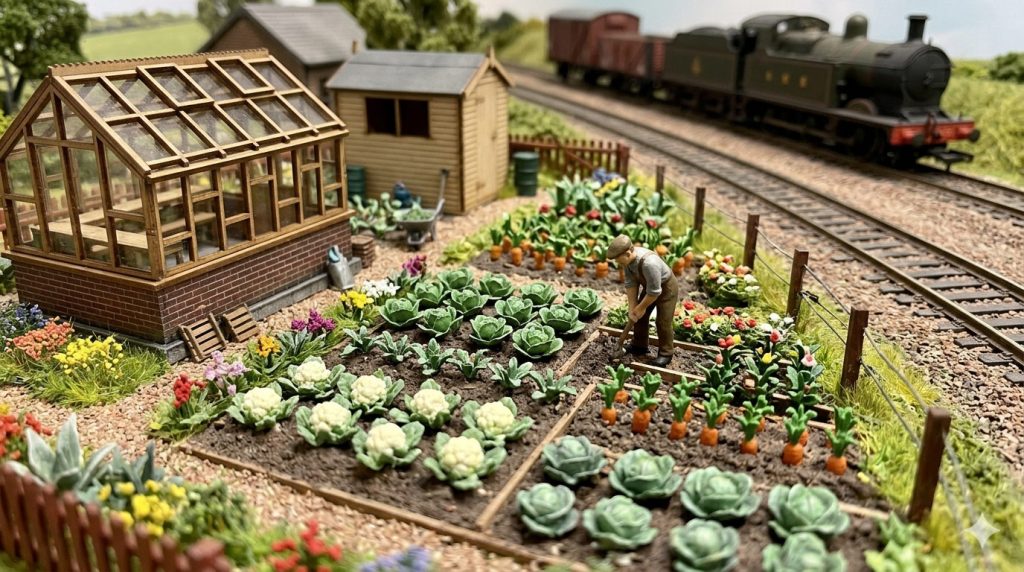
You’d be hard pressed to find a more quintessentially British lineside scene than a row of allotments. Corrugated iron sheds, a crooked fence, vegetable patches in various states of tidiness — it’s instantly recognisable and, frankly, quite satisfying to build.
Use figures tending to plots to bring it to life. Preiser, Faller and Noch have suitable pre-painted figures in their ranges (if you’re modelling in OO, their figures are strictly speaking HO/1:87 scale but with careful placement you can make them work. If you’re happy to paint the figures yourself, then ModelU 3D has a good selection of figures performing a number of gardening-related activities in their range. The key thing here is variety: not every shed should be the same colour, not every plot should be the same shade of green. Real allotments are wonderfully chaotic, and your model should reflect that.
2. Derelict Siding
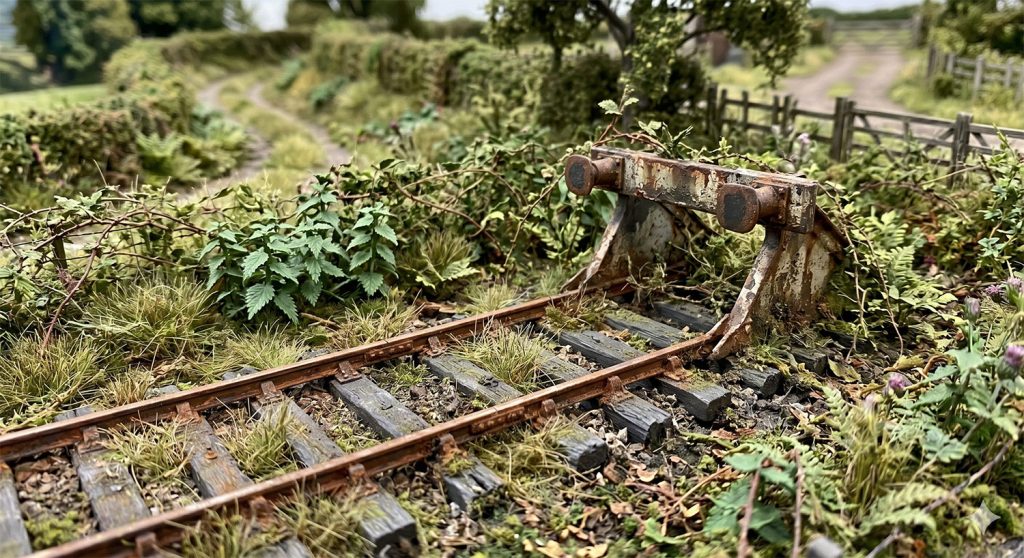
There’s something quietly melancholy about a forgotten siding — and that makes it a good candidate for inclusion on a layout. A length of tired and rusty track slowly disappearing under static grass and brambles, with a rusted, weathered wagon left to rot at the buffer stop. It tells a story without a single figure in sight.
A 12-ton vent van works brilliantly for this (something like the Parkside PC591 would be a good choice as it comes in kit form, so you can add your own touch of decay as you build it). Weather it heavily: rust washes, chipped paint, maybe a broken door hanging open. It’s a small detail, but it matters enormously for the atmosphere of the scene.
A derelict siding is also a great way to fill a spare corner of your baseboard. All you need is a length of old track… even a bit of redundant steel track from the 1970’s & 80s will do the trick for this. It doesn’t even have to be connected to your main track. Simply glue it down, ballast it as normal. Then go to town with the washes, rust effects, stinging nettles, bracken and static grass tufts.
3. Signal Box Interior
One of the genuine advantages of OO gauge is that you can actually see into buildings if you light them properly. So time and effort spent detailing a building’s interior is time invested rather than wasted. And a signal box interior is one of the most rewarding things you can model at this scale.
Add a lever frame, a signalman figure (again, we highly recommend ModelU 3D), maybe a mug on the windowsill. Wire in a warm interior light — there are plenty of options for lighting… diy or Woodland Scenics Just Plug makes it a breeze to install — and the whole thing comes alive at dusk. It’s the kind of detail that stops people in their tracks at shows, and makes you grin when you flick the power switch in the railway room.
4. Cattle Dock
If your layout is set in the steam era, a cattle dock is an absolute staple. Wooden pens, a loading ramp, livestock figures milling about — and crucially, muddy ground (even though they were sometimes cobbled underneath). Mix plaster and acrylics to get that churned-up texture around the pens, or use a MIG Earth Paste. It should look like it smells a bit rum! The sort of smell that really clears the nostrils!
This kind of scene also gives you a natural reason to have cattle wagons sitting in a siding, which helps your layout feel operationally purposeful rather than just decorative.
5. Railway Arch Businesses
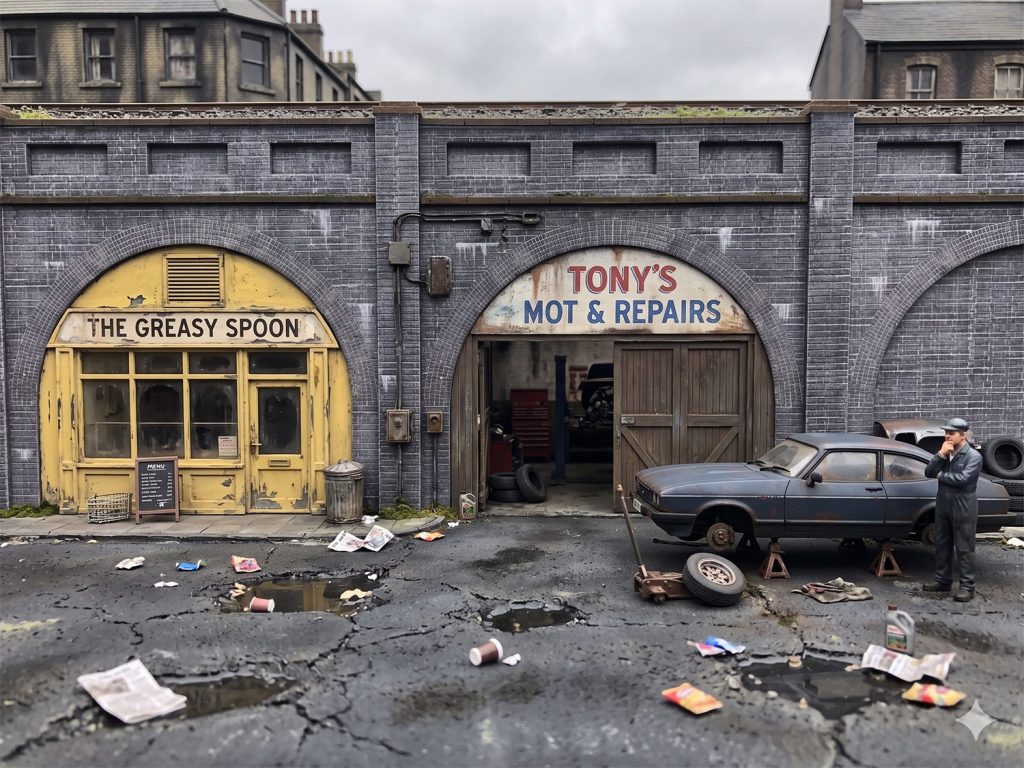
If your layout features a viaduct, don’t waste the space underneath. Get to work with the arch infills! Railway arches have historically housed all manner of businesses — small garages, scrap dealers, cafés, storage yards. It’s prototypically accurate, it fills what could otherwise be dead space, and it adds genuine character.
A tatty MOT garage with a car up on axle stands, and a figure in overalls works brilliantly. So does a coal merchant with sacks stacked by the kerb. Think about what would actually have been there in your chosen era and go from there. A quick search on Google Images will bring up plenty of ideas.
6. P-Way Maintenance Crew
Permanent Way workers are one of those scenes that feel immediately alive, and adding them can take just a couple of minutes. A small gang replacing a section of rail, or clearing lineside vegetation — it’s the kind of thing that gives your layout a sense of ongoing activity rather than a frozen moment.
For a steam-era layout, dark overalls and flat caps. For a modern image layout, high-visibility orange vests. Either way, group the figures naturally rather than spacing them evenly — real people don’t stand equidistant from each other, and neither should your figures.
7. Canal Scene
Railway and canal often went hand in hand historically, competing and then co-existing across the British landscape. A narrowboat passing under a red brick or bridge is a classic scenic combination, and it gives you a fantastic opportunity to experiment with water effects.
There are many choices when it comes to modelling water, with many scenic manufacturers having options available… Woodland Scenics & Deluxe Materials both do ready-to-pour water compounds — model water effects have come a long way, and the results can be genuinely impressive. Add clump foliage, static grass and Noch/Gaugemaster laser cut reeds along the bank, and take your time painting the base of the canal too, to get that depth of colour right. Or you can use Woodland Scenics Deep Pour Murky Water to get the look in one go. It’ll be well worth the effort, though.
8. Bus Replacement Service
This one’s a bit more tongue-in-cheek, but it works brilliantly as a cameo. A broken-down DMU was sitting at the platform, and a bus pulled up alongside to take on the stranded passengers. It’s a very British scene — and rather timeless, unfortunately.
Match your bus to your era carefully. A vintage single-decker for a 1960s layout; something more modern for a contemporary scene. A small crowd of disgruntled figures on the platform adds to the storytelling nicely.
9. Low-Relief Street Scene
Space is often the limiting factor on a home layout. Low-relief buildings — half-depth structures placed against the backscene — are one of the smartest solutions going. They give the illusion of a full townscape without eating into your precious baseboard depth.
The trick here is in the planting. Make sure the buildings connect convincingly to the ground level and to each other. A row of low-relief terraces with a proper pavement, lampposts, and a parked vehicle or two in front can look remarkably convincing. Low-relief building techniques are well worth exploring if you haven’t tried them yet.
10. Level Crossing
A level crossing is one of those natural focal points that draws the eye — and the nice thing is it also justifies a queue of road vehicles, which adds life to your layout without requiring a huge scenic area.
Whether you go for traditional gates or modern barriers depends on your era. Either way, a small crossing keeper’s hut and some era-appropriate vehicles waiting patiently complete the scene. If you want to go further, a working crossing with a servo-operated gate is a satisfying little project.
11. The Country Pub
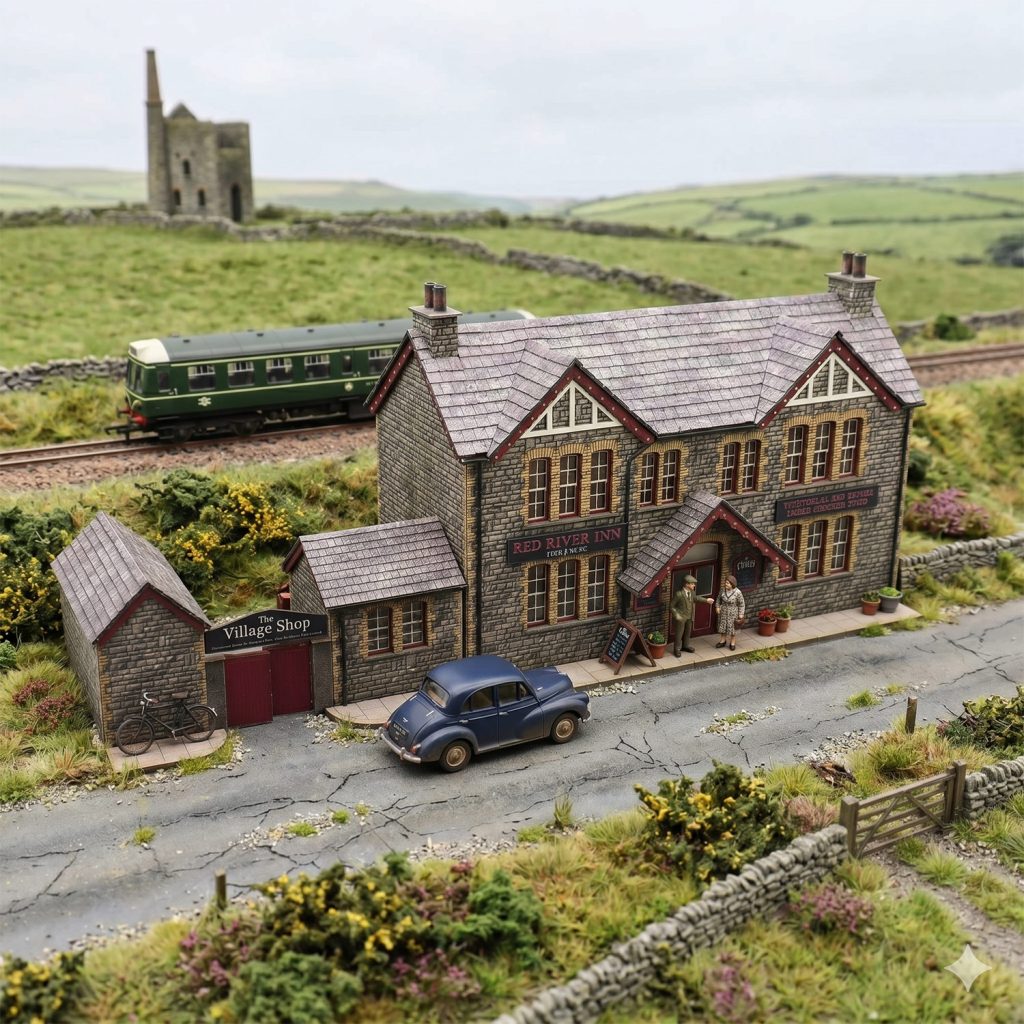
There are very few British scenes that don’t benefit from the presence of a pub. Happily, model railways are not among them. Indeed, the inhabitants of your miniature world surely deserve a pint at the weekends! A quaint Victorian, stone-built pub with a beer garden — a few picnic benches, some figures with glasses, a hanging basket or two or a few planters in bloom, and you’ve built yourself a scene that adds warmth and familiarity to any rural layout.
It also gives you something to name, which is always fun. Name it after a real pub from your area, or something personal. Nobody will know, but you, and that’s rather the point with all this stuff… To have some fun. Whether you go down the ready to plonk route with a Bachmann Scenecraft or Hornby Skaledale resin pub, a card kit from Metcalfe or SuperQuick, or you fancy something more challenging like the Scale Model Scenery KX120 Victorian Ale House, adding a pub scene to your layout can be great fun. Park a car up outside, maybe add a couple of punters just about to enter the pub, and park up the local midwife’s Morris Minor outside and you’ve built yourself a fun little scene.
12. Industrial Scrapyard
For those who enjoy texture-heavy, gritty modelling, a scrapyard corner is hard to beat. Offcuts of plastic rod and wire, crushed foil, bits of sprue — all painted up with rust washes and oil stains — can create an incredibly convincing pile of scrap metal for very little outlay.
This is one of those scenes where the usual rules of neatness go out the window. The messier and more chaotic it looks, the better. Don’t overthink it — just start piling things up and see what happens.
13. Footbridge Spotters
A classic for good reason. A footbridge over the main line, with a handful of figures leaning on the railings — notebooks in hand, perhaps a camera raised — captures something genuinely nostalgic about British railway culture.
It’s also a scene that works across eras, from the schoolboys of the 1950s to the more organised enthusiasts of later decades. Position your figures so they’re actually looking toward the track, not gazing into the middle distance. It sounds obvious, but it makes all the difference.
14. Farm Harvest
A worked field alongside the railway is a lovely way to fill a corner of your layout that might otherwise just be static grass. A tractor — a Fordson Major or Massey Ferguson, depending on your era — working through a field, with varying heights of static grass to represent cut and uncut crops, creates real visual interest.
The key is in the grass. Mix different lengths and shades to get that harvested look. Applying static grass well is one of those techniques that genuinely elevates a layout, and a harvest scene gives you a great excuse to practise it.
A Few Tips Before You Crack On
Whatever scenery ideas you decide to pursue, a few things are worth keeping in mind before you reach for the glue.
- Watch your scale. It’s tempting to mix in HO scale (1:87) figures or buildings when you can’t find exactly what you need in OO, but the 15% size difference is more noticeable than you’d think — especially in figures and buildings side by side.
- Mute your colours. Real landscapes aren’t neon green and solid grey. Mix your flocks, add washes, and aim for the slightly muted, weathered palette that actual outdoor scenes have. It reads as far more convincing.
- Plant your buildings. A structure sitting on top of flat grass looks like it’s floating. A small amount of scenic scatter or filler around the base of any building, blending it into the ground, makes an enormous difference to how settled and real it looks.
- Protect your track. When working with adhesives or paints near the running lines, mask the rail heads. Glue on the rail surface causes all sorts of electrical headaches later — and yes, that’s a lesson most of us have learned the hard way.
The best layouts aren’t built all at once. They grow, scene by scene, corner by corner, with each little cameo adding another layer of story. Pick one idea from this list, give it a go, and see where it takes you. And if you’ve built something you’re particularly proud of, we’d genuinely love to see it — drop us a message or share it in the comments below.